This blog is now an archive. We are no longer updating this blog.
For latest go to:
This blog is now an archive. We are no longer updating this blog.
For latest go to:
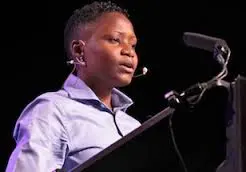
By Val Kalende
Last week, Ugandan gay activists announced February 10 as a Global Day of Action against the Anti Homosexuality Bill. In phenomenal world-wide outrage, the draconian proposed law has almost equaled Idi Amin and Joseph Kony in tainting Uganda’s image. So much that in 2012, the Ugandan government paid over $1 million to an Ireland-based public relations firm in a campaign to “whitewash” the country’s image abroad. While I still meet people who think Africa is a country, I meet many more who know about an East African country where “gays are killed.” While people may have flawed assumptions about Africa or what it means to be gay in Africa, these responses point to an undeniable fact: global solidarity is becoming one of the most powerful weapons against Africa’s homophobia.
I believe, as Dr. King believed, that “Injustice anywhere is a threat to justice everywhere.” Solidarity is not a sympathy-seeking, charity-seeking project calling for White messiahs to save the world. Solidarity, as I understand it, speaks to a hidden desire in every human being to be human. Simply stated, solidarity is the African concept Ubuntu. To stand in solidarity with a cause for which one is not directly affected takes more than recognizing it as a problem of the other.
At Kuchu Diaspora Alliance, a network of Ugandan LGBT people in the Diaspora, we are “amplifying the collective voice of our movement,” a slogan that is representative of the collective power of solidarity. With an African LGBT Diaspora beginning to emerge, we are organizing—in partnership with activists on the ground—for global action.
In the United States, the campaign against Uganda’s anti-gay bill has redefined what it means to stand in solidarity with LGBT struggles abroad. When Hilary Clinton made a historic statement in support of LGBT people everywhere, “LGBT rights are human rights and human rights are LGBT rights,” the importance of global solidarity began to resonate with most activists. In fact, there had been discussions on how to diminish harm should similar laws be proposed in other countries. And, as witnessed in the past four years, gay rights have come under attack in Malawi, Zambia, Cameroun, Nigeria, Sierra Leone, Zimbabwe, and Russia.
In Cameroun, activists are under attack, and some have been killed. In Nigeria, the outcry of LGBT people is loud. And yet, only a handful of cases are reported. From current trends of events, backlash against HIV/AIDS interventions can be predictable. Witch-hunts, blackmail, arrests, and murder will continue to rise. One thing all these countries seem to have in common is the influence of religion and the pushback against Western imperialism.
In Russia, global solidarity and the Olympics have shed light on the country’s anti-gay “propaganda” law. In Uganda, politicians are beginning to respond to international criticism over the right-wing sponsored “Jail all gays” bill and are now turning to the Church to be at the forefront of the campaign against homosexuality. The church in Africa has become a safety net for homophobia mainly because it is safer to bash gays with the bible than it is to bash gays with politics.
Clergy in Uganda are mobilizing for a 2016 ballot on homosexuality whereby winning an election will be determined by a candidate’s stand on homosexuality. There is likelihood of growing fractions in the Anglican Church as African Archbishops move to respond to Canterbury’s recent communiqué on its stand on homosexuality.
But while Uganda’s upsurge of homophobia has provided reasons to investigate anti-gay laws elsewhere in Africa, I believe it is time for global solidarity against homophobia to move beyond Uganda. As a community organizer who has worked on the ground, I understand that words of encouragement from afar bring hope, even in hopeless situations.
Uganda’s anti-gay bill has galvanized global solidarity for gay rights on the continent. That is not a bad thing. Because while conservative evangelicals hail Uganda for “showing leadership” for its anti-gay law, Uganda has become the spin of Africa’s new gay rights civil rights movement because of its unique situation. My fear is that we seem to be using one country’s story to understand a continental problem. In the process, not much is known about the situation in other countries. The “global day for action” campaign can be applied to other countries where anti-gay laws are being debated or have been sanctioned. It should become a worldwide campaign with activists protesting anti-gay laws at embassies around the world. These actions can be coordinated with activists in African countries affected by such laws such that meaningful outcomes can be achieved.
Change is happening albeit not ostensibly. It is those small ripples of change that can be harnessed to long-term gains. A global day of action beyond Uganda might be just what needs to happen.
By Leigh Ann van der Merwe, Director, S.H.E.
There is a voice that is silent from Africa… a voice no one hears, despite its loud scream. There is a faceless person, despite standing in a crowd of millions. That person has a name, a face, and an identity. These are the transgender women in South Africa. Strides have been made for the rights of transgender people in South Africa, yet many of the issues affecting black, impoverished transgender women go unattended. This is where the idea of a feminist collective dedicated to addressing the issues of transgender women in South Africa originated and S.H.E. (Social, Health and Empowerment feminist collective of transgender and intersex women of Africa) was established.
 Unlike our white privileged counterparts who may navigate and transition due to their economic statues, Black Transgender women are often poor and marginalised. Access to hormone treatment is generally perceived as a privilege instead of a human right to treatment. There are many barriers to gender affirming services in the public health service in South Africa. Only two public facilities provide care of this nature. Both currently have a 26-year waiting list. Private medical practitioners only treat on a pay-for services basis.
Knowing your rights are intrinsically linked to privilege is painful for us and divisive for our movement. We can’t hide or choose a particular type of privacy as we endure stares, harassment and violence within the public systems of South Africa. In post-colonial, post-apartheid South Africa, we must talk about these differences across race and class divides.
Anecdotal evidence suggests that transgender people of colour in South Africa are at heightened risk of experiencing violence and hate crimes. The violence transgender woman of colour experience in South Africa is broad and varied. We’ve read articles and seen videos documenting physical violence. But, systemic violence is silent, invisible, and violates transgender women as they try to access services. Often, transgender women are categorised as men and included in MSM/ HIV research and services. This prevents many transgender women from accessing health services. Transgender women face increased barriers to finding employment, which often leads them to sex work. There they are subject to arbitrary arrests from police. It is within this vicious circle that they become vulnerable to sexual violence and rape. And, it is heightened when, in police custody, they are locked up with cis-gender men (i.e. individuals assigned as male at birth and identify as male).
As we advocate for recognition, we face both internal and external challenges. S.H.E has chosen a feminist framework in which to organise. Our struggle plays against the backdrop of a racially challenged South Africa, and, as underprivileged South Africans, we fight many isms (classism, racism, chauvinism, patriarchy). The feminist maxim of equality in substance and process is of paramount importance to our work. Yet, still we must justify using a feminist framework for our analysis. We must justify a womanist approach2 to our work, and we have to explain why we want to advocate for our rights within mainstream women’s efforts. Some argue that transgender women cannot use a feminist approach to organising, based on the notion that we enjoy male privilege. But the violence and discrimination that we suffer is based, precisely, on the gender stereotypes we transcend. These conceptual difficulties are part of why it is not easy for projects such as ours to raise the resources to function effectively. S.H.E runs programs informed and led by transgender women. The leadership of the organisation is comprised mostly of transgender women from the continent. We strive to make our employment policies transgender women specific. These ideals support a mission and vision, underpinned by human rights, equality and freedom for the very people we wish to serve. To implement this mission requires adequate resources.
Well-meaning researchers, and scholars who take for granted that transgender women can be producers of knowledge, but not subjects of our own struggle, compound the challenges of South African transgender women. Many come to South Africa to research and document the experience of transgender women, but do not link these studies to advocacy strategies or for change rooted in our communities. When they leave, nothing is altered in advancing the rights of transgender women. I am that transgender woman featured in so many Ph.D dissertations, HIV research, and documentation of violent experiences. I have a face, I have a name, and I have an identity. There needs to be a better effort at forging relations between activists and those supporting our efforts from the West, based on the understanding that African problems have to be solved by African people, with African solutions. We transgender women must be seen in our racial, class, and other diversities. Ultimately, it is we who are the relevant stakeholders in our struggle for equality and rights.
S.H.E Coordinator and Founder Leigh Ann van der Merwe was born in Ugie, Eastern Cape of South Africa. Growing up as a gender questioning person, she struggled to conform to typical male gender codes and as a result always felt left out both in family life and at school. Leigh Ann’s first gender challenge was attempting to play on the Ugie High School Netball team. Netball is a female sport code in South Africa. She struggled through high school and graduated from Blackhealth High School in 2000. She enrolled for an LL.B degree with the University of the Western Cape in 2001 but did not complete due to financial difficulty.
Through another trans woman that Leigh Ann was introduced to trans activism in 2007. Her experience of activism includes being a candidate in the Transitioning Africa Exchange Program from 2010 to 2011; She was a fellow in the Open Society/Austrian American Foundation/Transgender Centre of Excellence program in Salzburg, Austria, October 2011 and presented at a transgender consultation at UNAids in Geneva, November 2011. She holds a seat on the United Nations steering committee for transgender people in the Global South.
Leigh Ann reviewed a number of gender literature resources produced by other NGO’s and was part of the study team on a UNFPA report on the challenges of sex workers in the East London area. She is actively involved with NGO’s dealing with gender & women’s issues, HIV and public health. She is the secretary of the board of an East London based NGO working with orphans and vulnerable children. She presented two papers at the first ever IGLHRC sponsored, Gender Dynamix Transgender Health and Research Conference November 2011. In 2012, Leigh Ann received an award from the Masimanyane Women’s Support Centre in recognition of her work as a Women’s Rights Defender. She holds a certificate in Community Journalism from the University of South Africa. She is passionate about feminism and women’s rights.
 By Grace Poore
Regional Program Coordinator for Asia and the Pacific Islands, IGLHRC
Many countries in the Southeast Asian region are incrementally shifting on lesbian, gay, bisexual and transgender (LGBT) people’s rights:
The Malaysian government however continues to stubbornly reject the rights of LGBT people. This position reverberates throughout state institutions, encouraging hostility, discrimination, and abuse by state and religious authorities.
In October, Judge Siti Mariah Ahmad, of the high court of Seremban in Negeri Sembilan, one of Malaysia’s thirteen states, struck down a first-ever constitutional challenge brought by four Malay transwomen who sought the court’s protection for being unfairly targeted by Article 66 of the Negeri Sembilan sharia law.
Mohammad Juzaili Mohammad Khamis (24), Shukor Jani (25), Wan Fairol Wan Ismail (27), and Adam Shazrul Mohammad Yusoff (25) work as bridal makeup artists, and identify and dress as women. In August 2012, they applied for judicial review of Article 66, which criminalizes men “who dress in women’s clothes and behave like women in public.” They claimed that it violated their rights under Articles 5, 8, 9, 10 and 4 of the Malaysian federal constitution, which guarantees personal liberty, nondiscrimination, freedom of movement, freedom to express one’s identity, and supersedes any local state law that challenges the federal constitution.
Their lawyer argued that Article 66 was unconstitutional because it penalized individuals for “an attribute of their nature that they did not choose and cannot change.”
Judge Siti Mariah, who heard the arguments in the judicial review, disagreed. In her decision, she said, “The undisputed facts are that the applicants are born as males, they are male to female transsexuals, and the evidence of the psychiatrist is that they have jiwa wanita (soul of a woman)… Section 66 is part of the teaching of Islam and the applicants are Muslims. They cannot be exempted from it.”
PT Foundation, an HIV/AIDS organization in Malaysia, reports there are 10,000 mak nyahs (the local term for male transsexuals), in the country. Seventy to eighty percent of mak nyahs are Malay and Muslim while the remaining twenty percent are minority ethnicities. Most mak nyahs do not have gender reassignment surgery because it’s too costly and requires travel outside the country. They fear too that their families will not carry out the Muslim burial rites if they are not viewed as a man or a woman.
Malaysian rights advocate, Thilaga, working in the Justice for Sisters campaign for the rights of mak nyah, says, “Transgender people don’t report violations by police or religious officers because they don’t expect justice. Often, they don’t know their rights and lack resources to go to court to fight charges.” The four applicants in the Negeri Sembilan case attest to this. Mohammad Juzaili was detained four times in 2010, charged three times, convicted twice and fined 1700 Malaysian ringgit ($550 US); Adam Shazrul was arrested twice, convicted once, and fined 800 ringgit ($260 US); Shukor Jaini and Wan Fairol were each detained twice.
Muslim mak nyahs can face up to six months in prison from Malaysian sharia courts. They are sometimes forced to attend Islamic religious classes where they are pressured to reform and give verbal assurances that they will stop being trans. They are particularly vulnerable to routine arrest and penalized by police and Islamic religious officers who verbally humiliate, physically and sexually abuse them while in custody.
Non-Muslim mak nyahs, while not subject to sharia laws, can be arrested and convicted for “disorderly or indecent behavior,” with penalties ranging from 25 to 100 ringgit ($10- $30 US) and two weeks to three months in prison.
During the August hearing, Judge Siti Mariah, visibly disturbed by reports of custodial abuse of the applicants, questioned the representatives of the state department and Islamic Affairs department about the way the applicants were treated. She also questioned the definition of public space, saying, “the moment they step out of their house, it’s public space,” suggesting that religious officers were using sharia law to target the mak nyah community. She questioned if Article 66 applied to the applicants “because they are not men, neither women.”
In her decision last week, Judge Siti Mariah remarked, “The Islamic Religious Department needs to be ‘lebih berhemat’ (more professional),” instructing the Department to work with PT Foundation “to give counseling to transsexuals.”
If we are to better protect the human rights of LGBT people in Malaysia, a far more explicit warning must come from the courts. The Negeri Sembilan Islamic Religious Department should be charged to investigate, prosecute and convict its own religious officers for acts of verbal, physical, mental and sexual abuse against those in their custody, for supposedly breaking morality laws.
Sharia judges across Malaysia must hold accountable Islamic religious officers (and police officers subject to sharia courts) who misuse their authority, take advantage of people’s vulnerabilities, humiliate them, and mistreat with impunity those they are hired to protect—including lesbian, gay, bisexual and transgender people.
For more on mak nyah experiences, see Nisha Ayub’s presentation (pdf) at the International Gay and Lesbian Human rights Commission panel at the 2012 Creating Change conference.
Grace Poore, the author, can be reached at gpoore@iglhrc.org
por Pedro Garcia, Paula Ettelbrick Fellow
To read the original article in English, visit: Chilean Paradoxes: LGBT rights in Latin America
Durante los últimos años ha habido avances importantes en materia de derechos humanos para la población gay, lesbiana, bisexual y transexual (LGBT) de América Latina. El reconocimiento de uniones civiles para parejas del mismo sexo en Brasil y en Uruguay, matrimonio homosexual en la Ciudad de México y en Argentina, y leyes que protegen la identidad de género en Bolivia, Chile y Argentina. Estos cambios ponen en duda viejos estereotipos que califican al subcontinente como una región conservadora, machista, y dominada por la moral de la iglesia católica.
La lucha por los derechos humanos LGBT en América Latina no es un camino de un solo sentido. Existen paradojas dentro de los Estados y entre las naciones. El año en que la Ciudad de México legalizó el matrimonio para parejas del mismo sexo, únicamente el 29% de la población de la ciudad apoyaba el derecho de estas parejas a adoptar. En Ecuador, la Constitución prohíbe explícitamente la discriminación por motivos de orientación sexual, pero también rechaza textualmente el matrimonio y la adopción por parejas del mismo sexo. EL matrimonio gay es legal en algunos casos en Brasil, pero la población transgénero sigue siendo víctima sistemática de violentos crímenes de odio. En el 2009, Brasil reportó el mayor número de asesinatos a personas transgénero del continente. En Costa Rica el diputado evangélico Justo Orozco, quien ha afirmado que la orientación sexual es un pecado y debe tratarse, es también presidente de la Comisión de Derechos Humanos.
Chile es una gran ilustración de estas paradojas latinoamericanas. Cuando Michele Bachelet, mujer socialista, asumió la presidencia en el 2006, grupos LGBT vieron una oportunidad para hacer avanzar sus derechos en un país de un conservadurismo rígido. Irónicamente, la mayor parte del debate y legislación sobre temas LGBT tuvo que esperar hasta la presidencia actual de Sebastián Piñera, el primer presidente de derecha desde la época de Pinochet.
Durante estos últimos meses, tres temas LGBT han recibido gran atención de la población chilena: una ley antidiscriminación, impulsada por una condena al Estado chileno de la Corte Interamericana de Derechos Humanos (CIDH) y el asesinato del joven homosexual Daniel Zamudio; un proyecto de ley para permitir las uniones civiles pero prohibir el matrimonio a parejas del mismo sexo a nivel constitucional; así como el anuncio de que el Fondo Nacional de Salud chileno, el Fonasa, costeará cirugías de cambio de sexo a personas transgénero.
Continue reading “Paradojas Chilenas: Derechos LGBT en América Latina”
By Pedro Garcia, Paula Ettelbrick Fellow
Para leer este artículo en español, mira: Paradojas Chilenas: Derechos LGBT en América Latina
Over the past few years, there have been important milestones advancing LGBT human rights in Latin America. Recognition of civil unions in Brazil and Uruguay, same-sex marriage in Mexico City and Argentina, laws protecting gender identity in Chile and Bolivia, and historic, progressive legislation in regard to gender identity in Argentina. These advances question old stereotypes of the region as a conservative macho culture dominated by the morals of the Roman Catholic Church.
The fight for LGBT human rights in Latin America isn’t a one-way street. Paradoxes arise among and between countries. When Mexico City legalized same-sex marriage by legislative action, only 29% of the city’s population supported the right to adoption by same sex partners. In Ecuador, the Constitution prohibits discrimination based on sexual orientation yet bans same-sex marriage and adoption. Gay marriage is legal on a case-by-case basis in Brazil but transgender people continue to be the target of violent crime. In 2009, Brazil reported the highest number of murders of transgender people for the region. In Costa Rica, the president of the Legislative Assembly’s Human Rights Commission expressed his belief that sexual orientation is a sin that can be treated. Clearly, homophobia and transphobia are widespread in the region.
Chile: World of Latin American paradoxes.
When the Chilean socialist president Michele Bachelet took office in 2006, LGBT groups saw an opportunity for advancing their rights in a country with rigid cultural conservatism. Ironically, most of the debate and legislation about LGBT issues had to wait until Sebastián Piñera, Chile’s first right-wing president since Pinochet left office.
Three issues have received particular attention from the Chilean population: An anti-discrimination law, prompted by a ruling in the Karen Atala custody case condemning Chile by the Inter-American Court of Human Rights and the homophobic murder of Chilean youth Daniel Zamudio, a bill for same-sex civil unions and ban on same-sex marriage, and , an announced health coverage of sex reassignment surgeries by the country’s public health plan.
Continue reading “Chilean Paradoxes: LGBT rights in Latin America”

By Grace Poore
Regional Program Coordinator for Asia and the Pacific Islands
Women’s human rights defenders from Indonesia arrived in New York this week to report to the Committee for the Elimination of Discrimination Against Women (CEDAW) about flagrant violations experienced by women and girls in Indonesia across all sectors of society – female circumcision, unsafe abortions, forced sterilization of minority women, marital rape, polygamy, weak implementation of the domestic violence law, police abuses, abuses by domestic worker recruitment agencies, failure to grant reparations to women sexually violated during conflicts with the Indonesian military and police forces, judicial disregard for violence and discrimination against women, rampant abuses against women migrant workers, and many more.
Yet, violence and discrimination against lesbians, bisexual women and transgender (LBT) women was not on the agenda. The spread of intolerance by religious fundamentalists had driven a wedge within the Indonesian women’s movement. Except for one 145-page shadow report that mentioned sexual orientation and gender identity (SOGI) once, LBT people were invisible. Even Komnas Perempuan, the National Commission of Women was reluctant to raise LBT issues. As one Commissioner explained, “The fundamentalists are saying that when we push for women’s rights we are pushing for same sex marriage. So if we bring up LBT, it will weaken our advocacy.” Another Commissioner assured me, “We can raise the LBT issue at the next CEDAW session.” But that would be five years down the road!
Sri Agustine, director of Ardhanary Institute, a national LBT organization in Indonesia admits, “When I arrived in New York, I was pessimistic because I was the only one from my organization, and the other NGOs [non-governmental organizations] did not want to mention LBT issues because [other] women’s issues were urgent. But I’m a woman also.”
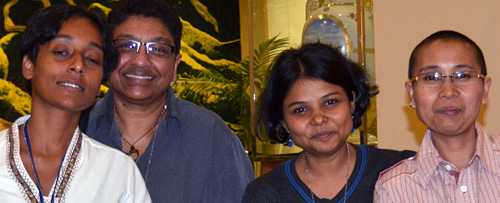 L to R: Sherlina Nageer from Guyana, Grace Poore from IGLHRC, Dorathy Benjamin from IWRAW Asia Pacific, Sri Agustine from Ardhanary Institute. (Photo courtesy of Ardhanary Institute.)
Women’s NGOs Exclude LBT Issues
Since 2000, LBT people in Indonesia have been part of the women’s movement, fighting for equality for all Indonesian women. Yet the CEDAW Convention does not apply to LBT people because LBT rights are not seen as women’s rights by the Indonesian state. This attitude is in part due to the resistance of women’s NGOs to recognize the multi-dimensional discrimination and “layered violence” that LBT people face for being women and also because of their sexual orientation and gender identity.
Agustine was pressured not to make any statements about LBTs to the CEDAW Committee. It saddened me to see how the forces of religious extremism had managed to compartmentalize advocacy and silence even those who were allies – allies who quietly supported LBT people but publicly could not afford to be associated with LBT rights.
The International Gay and Lesbian Human Rights Commission (IGLHRC) was aware that in Indonesia, fundamentalist thugs were calling up LBT groups and leaving threatening telephone messages, stalking LBT activists, violently disrupting human rights workshops and film festivals, halting conferences, using the media to incite violence against LBT people, and posting stickers on restaurant windows and banners in public spaces that said, “Destroy Gays and Lesbians.” This climate of hate and intolerance in the name of religion and morality has grown steadily since 2008 and exposed the LGBT community in general to vigilante attacks, police complicity with attackers, curbing freedom of association and assembly, stifling freedom of expression, and eroding LGBT people’s access to justice.
Decentralization
Ironically, these human rights erosions grew out of the decentralization process initiated by the Indonesian government to grant autonomy to local provinces and districts so they could govern themselves, including create their own local laws (or bylaws). Religious extremists usurped the decentralization process to create discriminatory bylaws in their provinces and enforce them with impunity in the name of morality and religion. They targeted sexual rights, reproductive rights, women’s rights and LBT rights. They regulated what women wore, the length of their hair, what public spaces they could access, and how they appeared – with penalties for butch lesbians (lesbian tomboys) for not looking “feminine enough” or transgender women (waria) for “acting like women.”
Ardhanary Institute reports that since 2008, employment discrimination and sexual bullying in schools sharply increased because of the “spread of intolerance.” By 2010, family violence against LBT people had doubled in Jakarta, the capital city, and tripled in the provinces outside Jakarta. Lesbians, particularly lesbian tomboys were increasingly being “sexually abused by fathers, uncles and brothers to change the sexual orientation of lesbians.” Those who risked going to the police faced ridicule and blame for provoking the violence and were lectured by police officers to change their sexual orientation and gender identity. Reports on the violence were quashed by police to prevent “smearing family reputation.”
According to Komnas Perempuan, the Indonesian Women’s Commission, the Ministry of Home Affairs was not properly monitoring and ensuring that the local bylaws were nondiscriminatory and in compliance with international human rights treaties that Indonesia has ratified, including the CEDAW Convention.
These realities challenged the suggestion that LBT people could wait another five years before their issues were brought to the CEDAW Committee. Agustine and I negotiated with the NGOs. Finally, they allocated eight minutes out of seventy minutes, which was fair given the number of NGOs wanting precious face time with CEDAW Committee members. Following our presentations, Komnas Perempuan and the leadership of the CEDAW Working Group of Indonesia revised their statements to include SOGI. They requested from Ardhanary Institute a regular supply of data so they could include it in their educational materials.
State Review
On the morning of July 11, Agustine walked into the room where the 52nd session of the CEDAW Committee would commence, a broad smile on her face, eyes shining. “I feel confident,” she said, having earned the support of the other activists, her sisters in struggle.
The first question on LBT rights violations was raised by Patricia Schulz, CEDAW expert from Switzerland: “The bylaws on adultery passed in Aceh, if implemented, would expose adulterers to death by stoning, and LBT persons to caning, 100 lashes. This law is pending implementation. These bylaws represent grave violations of the rights of women to life, liberty and security… there is no commitment of the government to challenge these local and provincial laws. So I ask if your government plans to systematically review the local and provincial laws and strike down all the provisions that are discriminatory to women. You have the authority and the mechanisms to do so. Let me comment that decentralisation cannot mean that the human rights of women are invalidated at the local and provincial level. Democracy and rule of law, including anti-discrimination and equality law have to walk hand in hand, at all levels of the State structure. Governments are responsible for upholding the obligations arising from ratified human rights treaties, so I hope that you will give us very good news on that respect at our next constructive dialogue.”
The second question came from Silvia Pimentel, CEDAW expert from Brazil and Chair of the Committee: “Due to different risks associated with being identified as lesbians, bisexual, or transgender, LBT people who experience violence by family are reluctant to report their cases to police. Could the State: (a) enhance operational procedures, such as victim representation and witness protection? (b) sensitize frontline staff through training to address these specific fears?”
Harkristuti Harkrisnowo, Director-General of Human Rights in Indonesia’s Ministry of Justice and Human Rights responded, “The allegation about criminalization of LBT is incorrect because Indonesia does not criminalize LBT groups.” He added, “Regarding the punishment in Aceh, the law is not in place yet.”
Harkrisnowo stonewalled. He did not shed light on what measures the state would take to ensure protections. True, Indonesia has no sodomy law like many other Muslim countries in the region. But there are laws that disproportionately affect transgender people like the vagrancy and public order laws. The Anti Pornography Law classifies homosexuality as a “deviant act” that is punishable with jail and a fine.
In addition, a total of 154 local bylaws, regulate how women dress, including lesbians and lesbian tomboys who are punished for not appearing “feminine enough” and effeminate men and transgender women are punished for “acting like women.” Other bylaws force women to cover their heads, control what public places they can socialize in, and how late they stay out – all of which directly and indirectly affect LBT people.
The most egregious of the discriminatory local bylaws is the Aceh adultery law that was passed in 2009 by religious hardliners in the Aceh government. If this law is implemented, heterosexual people will be stoned to death for adultery and LGBT people will be caned 100 times and face 8.5 years in prison for homosexuality, which the law defines as sexual activity outside marriage. Civil society groups have filed for judicial review with the Indonesia Supreme Court. To date, there has been no decision. IGLHRC has learned that the new governor of Aceh favors amending the law. LGBT groups in Aceh fear that even if stoning is removed, the penalties for homosexuality could remain unless there is greater solidarity.
As Agustine said after a long day, “SOGI needs to be included in the definition of discrimination against women in Article 1 of the CEDAW Convention. The Indonesian government needs to ensure that Indonesian LBT people have equal access to the law and justice. The Indonesian government needs to promote acceptance of sexual and gender diversity among non-state actors and destigmatize our issues.”
By Sherlina Nageer
The Committee on the Elimination of Discrimination against Women (“CEDAW Committee”), meeting this month at United Nations headquarters in New York City, will review the human-rights record of several countries that are signatory parties to the Convention on the Elimination of All Forms of Discrimination against Women (CEDAW). In recent years the CEDAW Committee has increasingly included the rights of lesbian, bisexual, and transgender (LBT) women in its deliberations. During the week of July 9, Guyana will be reviewed. There has been strong engagement by LBT activists in preparation for the hearing. In the case of Guyana, an LBT-specific shadow report, “Human Rights Violations of Lesbian, Bisexual, and Transgender (LBT) People in Guyana,” was jointly drafted and submitted by three human-rights organizations: Guyana RainBow Foundation (GuyBow), the International Gay and Lesbian Human Rights Commission (IGLHRC), and the Society Against Sexual Orientation Discrimination (SASOD). I had the privilege of making an oral presentation of this report to the members of the CEDAW committee on July 9 at the UN.
There is a glaring gap in Guyana’s anti-discrimination policies and practices on the grounds of sexual orientation and gender identity: There is no specific protection for LBT people in Guyana’s constitution, or in existing legislation. While the argument may be made that certain articles of the constitution offer general protections against all kinds of discrimination, Guyana has retained archaic, colonial-era legislation, such as laws that criminalize cross-dressing and specifically penalize gender-nonconforming individuals. Retaining these laws reinforces discriminatory, heteronormative stereotypes, creating a de facto climate of intolerance for LBT people and negatively affecting their quality of life, mental health, and economic circumstances.
Continue reading “End Sexual-Orientation and Gender-Identity Discrimination in Guyana”
By Jessica Stern and Peter Dunne
On June 15, as U.S. President Barack Obama hosted a reception at the White House to mark Pride Month, the now annual celebration of lesbian, gay, bisexual, and transgender (LGBT) lives across the United States, there was much to contemplate about U.S. foreign policy and LGBT human rights.
While many celebrated advances made in the U.S. over the past year, this annual White House reception is an opportunity to recognize the efforts the Obama administration has made to promote LGBT human rights beyond U.S. borders. In December 2010 U.S. Ambassador to the United Nations Susan Rice spearheaded efforts to ensure that sexual orientation would remain part of a resolution condemning extrajudicial killings. Last December Secretary of State Hillary Clinton spoke movingly at the United Nations Human Rights Council in Geneva of how “gay rights are human rights and human rights are gay rights.” And President Obama the same day issued an executive memorandum calling upon U.S. diplomats to make LGBT human rights a priority in American foreign policy.
Continue reading “Celebrating Pride… Beyond the White House”
 OutRight Action International formerly known as International Gay and Lesbian Human Rights Commission